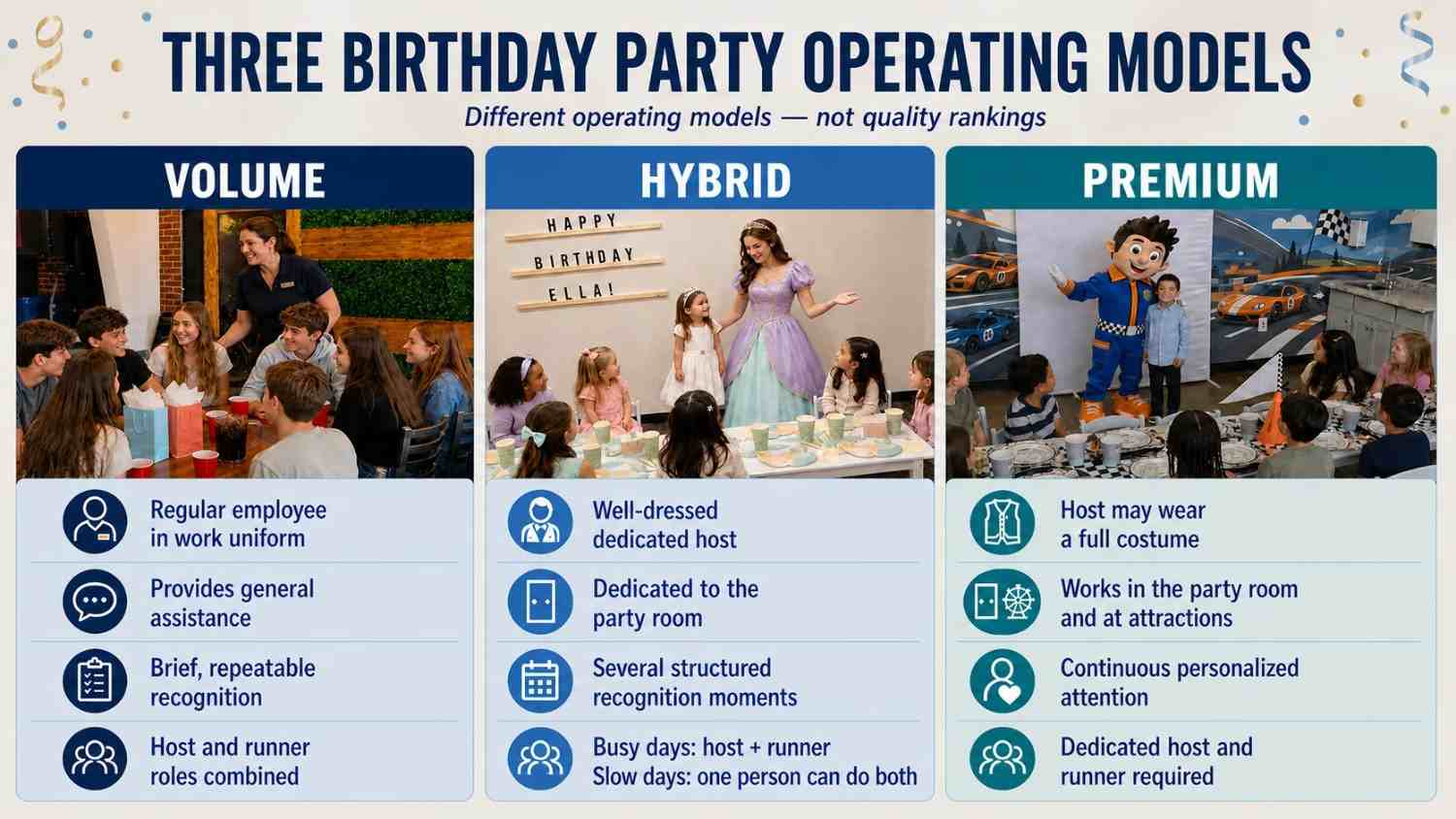
A practical framework for aligning economics, packages, experience, staffing, booking, marketing, revenue, retention, and measurement – then fixing the earliest weak link before buying more demand.
A family entertainment center (FEC) can have a busy party calendar and still have an unhealthy birthday-party program. More bookings do not tell you whether the offer fits the right customer, the team can deliver it, the party contributes economically, or the experience is building trust. A better program comes from aligning seven connected domains and repairing the earliest weak link before scaling demand.
A birthday-party operating system is the connected set of decisions, people, processes, and measurements that turns a party promise into a delivered event. It includes economics, packages, experience, staffing, booking and marketing, revenue and retention, and measurement and research. Each domain depends on the others; improving one while ignoring an earlier constraint can simply move the problem downstream.
A sound FEC birthday party strategy treats marketing and operations as one system. The diagnostic in this guide helps you find the earliest constraint before deciding whether to increase demand. That is a risk-management principle, not a universal causal law or a command to stop all marketing until the operation is perfect. Promotion should scale when the offer, capacity, and customer promise are credibly aligned.
If you cannot yet tell whether the program is financially healthy, begin with the companion guide, Stop Measuring Birthday Success by Party Count, before making a growth decision. It owns the detailed economics. This guide owns the wider system: how to identify the constraint and choose the right operating question next.
The weak-link rule: Start with the earliest domain that prevents the rest of the system from working. Repair it, reassess the system, and only then decide whether more demand is the right next move.
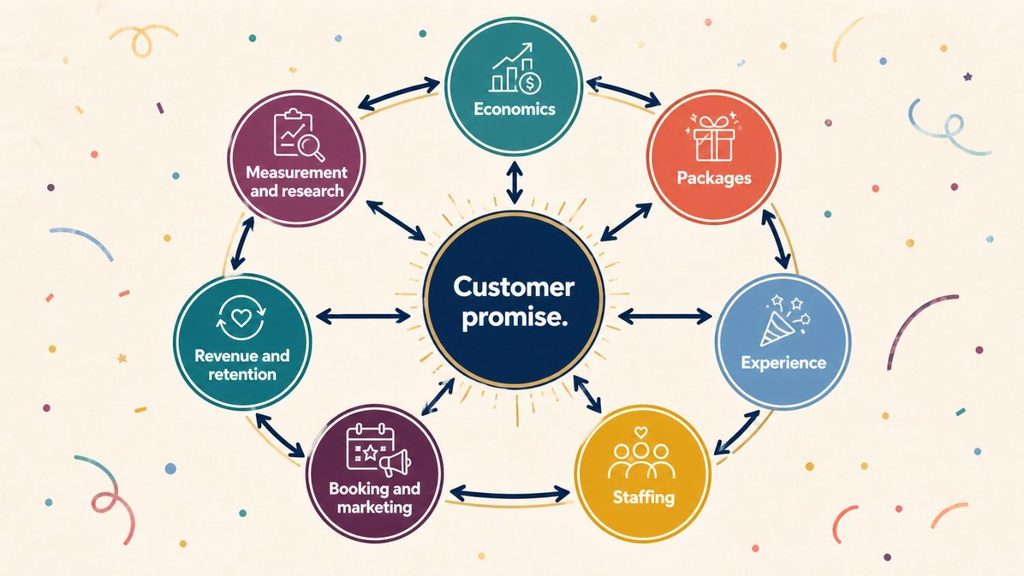
A healthy birthday-party program aligns seven connected operating domains around one deliverable customer promise.
Start by Defining What Success Means
Party count is useful, but it is an activity signal. It tells you that events are being booked or delivered. It does not tell you whether those parties are economically sound, operationally repeatable, or valuable to the customer.
A practical definition of success separates four views:
- Activity: Are inquiries, bookings, and delivered parties moving in the intended direction?
- Experience: Are the birthday child, parent, and guests receiving the experience the venue promised?
- Operational readiness: Are trained people, rooms, attractions, food service, and handoffs available when the party needs them?
- Economic health: After delivered revenue and genuinely incremental costs are understood, does the program support the venue’s business model and use constrained capacity deliberately?
The important word is separates. A rise in bookings can coexist with weak delivery. Strong reviews can coexist with unclear contribution. A profitable slot can still expose a staffing or capacity risk if the team cannot repeat it during peak periods. The operator needs all four views before calling the program healthy.
One practical health lens is to look for demand, documented economics, trained delivery, positive customer signals, and remaining capacity. This is operator judgment, not an industry benchmark. The same applies to the idea that a fully utilized schedule may prompt a price review: it is a useful management question, not proof that every full venue is underpriced.
Use this section to answer one decision: What must be true before we grow this program? If the team cannot define delivered revenue, relevant costs, labor and capacity, the unknowns belong in the first workstream. The detailed method belongs in the financial-health guide; this strategic guide needs only enough economic clarity to keep marketing, packages, and staffing from optimizing the wrong outcome.
Choose the Business Model Before the Tactics
Premium, hybrid, and volume models can all be legitimate. They are conditional operating choices, not a quality ranking. The right choice depends on the venue’s economics, leadership attention, training capacity, throughput, customer expectations, and ability to deliver the same promise repeatedly.
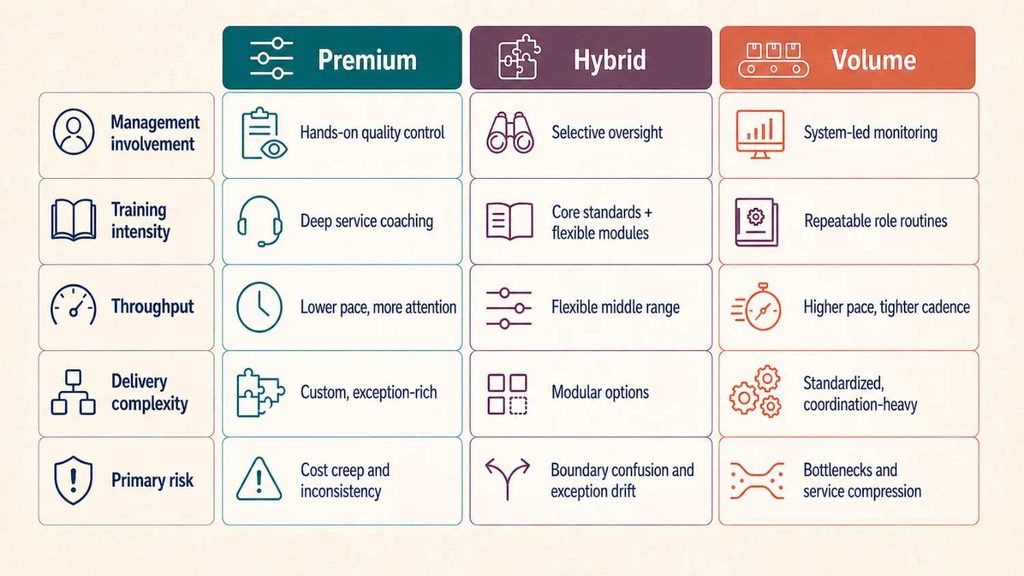
Premium, Hybrid, and Volume are conditional operating models, not a quality ladder.
Premium
A premium model usually asks more of management and training. The experience relies on deliberate facilitation, consistent handoffs, and quick correction when standards drift. It can fit a venue where an owner or highly engaged general manager stays close to the operation and where the team can support a more complex experience. Premium does not mean expensive decoration or a larger list of inclusions. It means the delivery system can credibly support a more attentive promise.
Hybrid
A hybrid model may fit a small group of closely managed venues or an operation that wants selected premium moments without building the entire party around intensive one-to-one facilitation. The operator decides which moments require dedicated ownership and which can be standardized or shared. The risk is an unclear middle: marketing promises premium attention, but staffing and capacity are built for throughput.
Volume
A volume model can fit larger, general-manager-led, high-throughput operations with standardized processes, substantial capacity, and less day-to-day owner involvement. It is not a lesser model. It has a different promise. The work is to make that promise clear, executable, and economically coherent instead of copying premium rituals that the floor cannot consistently support.
This management-involvement lens is informed operator judgment, not an industry law. Some venues will not fit neatly into any label, and the model may differ by daypart, customer segment, or party type. What matters is that packages, staffing, booking rules, and acquisition are designed for the same model.
Before choosing a package layout, campaign, or host structure, write one sentence that completes this prompt: Our party model is designed for this customer and occasion, under these operating conditions, with this level of service. If the team cannot agree on that sentence, the tactics are premature.
Design the Offer for a Real Customer and Occasion
A party package is not merely a price plus inclusions. It is a filter that shapes who books, what they expect, when they arrive, how the team prepares, and how much complexity enters the operation.
Start with the actual occasion. A party for younger children during a busy open-play period may need different pacing, visibility, and parent communication than a teen event seeking more independence. An escape-room venue without a conventional party room has a different delivery system from a multi-attraction FEC with food service and many simultaneous groups. The offer should reflect those realities instead of forcing every customer through one generic product.
Package clarity matters because every choice creates work. The party page must explain it. The booking process must configure it. The event coordinator must communicate it. The kitchen, attractions, host, and front desk must deliver it. This does not justify a universal package count. It just means every option should earn its operational complexity.
Ask four questions for every package:
- Who is this for, and what occasion is it designed to serve?
- What decision does the parent need to make, and what information reduces confusion?
- What people, space, timing, and handoffs are required to deliver it?
- What does the package deliberately exclude so the promise remains credible?
At one of our venues, removing a discount-led offer and moving toward a more premium position changed the mix of customers who responded. That is a bounded observation, not proof that the offer alone caused stronger spending, retention, or profitability. The narrower lesson is that the offer and positioning can influence who responds, so lead volume should be judged alongside customer fit and delivery requirements.
Build Value for the Birthday Child and the Parent
The party has at least two central customers. The birthday child needs recognition, agency, and a moment that feels different from an ordinary visit. The parent needs confidence that the venue understands the plan and will manage the group without quietly returning the event-manager job to the family.
For the child, value can be designed through observable moments: a host who knows the child’s name, a choice that changes the activity, a role in a magic moment, or a character interaction that visibly centers the guest of honor. These are examples of recognition, not guarantees of satisfaction or willingness to pay.
For the parent, relief is an operating goal. The parent should be able to watch, record, and socialize while the team manages the event. That requires clear ownership of arrival, transitions, food timing, attraction movement, group communication, and recovery when the schedule shifts. Define which burdens the venue is actually taking on and build the staffing and communication to match.
The child and parent views should be mapped together. An unexplained delay on arrival may reduce parent confidence. A perfectly efficient schedule that treats the birthday child like every other guest may fail to create an occasion. The product works when emotional moments and operational flow reinforce each other.
Treat the Dedicated Party Host and Handoffs as Part of the Product
In a hosted model, the dedicated party host owns continuity across welcome, transitions, parent communication, and recovery. Some higher-complexity deliveries separate a runner for logistics; leaner or higher-volume models may combine or distribute those duties. The goal is clear ownership that matches the model – not a universal staffing diagram. Train for observable behaviors and reliable handoffs, then use the dedicated-host and host-training guides for the full operating method.
An IAAPA Funworld feature on FEC triage illustrates the boundary well. It describes parents becoming frustrated when party hosts disappear and recommends clear communication about schedules and when the host will return.
The management question is simple: Who owns the guest journey at each point, and what happens when that person must step away? If the answer is “everyone,” the handoff is probably owned by no one.
Make the Booking Promise Executable
The booking process is where the public promise becomes an operating record. A parent may see a package page, choose a time, add food or gameplay, complete waivers, receive reminders, and arrive expecting a precise sequence. The staff may see a different mix of notes, schedules, kitchen tickets, room assignments, and capacity rules. The operating system has to keep those views aligned.
Map the chain from end to end:
- Package page and sales conversation
- Availability, capacity, and resource configuration
- Checkout, deposits, waivers, add-ons, and guest information
- Confirmation and pre-arrival instructions
- Internal event record and team handoffs
- Check-in, attractions, food service, room use, and final payment
- Review, referral, consented guest capture, and follow-up
Public platform pages show that these capabilities exist. For example, CenterEdge’s Advantage Events page describes customizable packages, event and resource scheduling, notifications, payments, records, waivers, and revenue allocation. That is capability evidence only. A platform cannot decide whether the package is right, whether the schedule is realistic, or whether the team will execute the configuration consistently.
At one of our client venues, a teen event booked during the younger-child rush created a poor fit for both groups. Owners responded by offering teen events in the first or last slot. That is a venue-specific scheduling decision, not a universal rule.
Audit the promise by comparing what the customer reads, what the booking system records, what each department receives, and what happens on the floor. Any mismatch is an operational defect even if the checkout technically works.
Scale the Right Demand – Not Just More Demand
Marketing is part of the operating system, but it is not the whole strategy. Its job is to bring the chosen customer to an offer the venue can credibly deliver within real capacity.
Before scaling promotion, confirm that the package is understood, the economics are documented, the team can deliver the intended experience, the booking record reaches the floor accurately, customer signals are acceptable, and there is capacity for the demand being pursued. This is a readiness gate, not a claim that every program must stop all marketing until it is perfect. New venues and deliberate tests may need controlled demand to learn. The size of the test should match the operation’s ability to observe and correct.
Within the marketing domain, Attractions Marketing Pros uses the term birthday party flywheel system for a subsystem that connects influencer activity, Meta and Google advertising, and follow-up. It does not replace the broader birthday-party operating system but supports it.
There is no universal channel mix. A premium model may emphasize positioning, referral quality, and fewer better-matched inquiries. A volume model may need broader acquisition, clear self-service booking, and reliable throughput. A hybrid may separate campaigns by occasion or daypart. The right question is not “Which channel gets the most leads?” It is “Which demand matches the chosen model, credible capacity, and customer promise?”
If promotion is working but the operation is not ready, more demand may amplify cancellations, confusion, rushed handoffs, or inconsistent delivery. Fixing the earliest constraint can be a more responsible growth decision than increasing spend.
Capture Revenue and Retention Beyond the Base Package
The party relationship extends beyond the base package, but every extension should fit the experience rather than clutter it. Food and beverage, gameplay, upgrades, photos, take-home items, or guest options may create ancillary value when the economics and delivery requirements are understood. None should be treated as a guaranteed lift.
The guest list also represents future relationships, subject to consent and appropriate data practices. A venue can design a handoff from the event to a review request, referral opportunity, future visit, or reminder. The sequence should be useful and proportionate. Capturing data without a clear customer benefit or sending generic follow-up simply moves friction into another channel.
At the event, the host or manager can ask whether the child and adults enjoyed the party and address a recoverable issue before departure. A review request can follow when the experience supports it. The program should never assume that asking creates a positive review or that a positive review proves economic health. Reviews and referrals are customer signals to interpret alongside delivered revenue, capacity, and operating quality.
Apply the FEC Birthday Party Strategy Diagnostic
The minimum measurement view should cover four signal groups without becoming a full KPI encyclopedia:
- Economics: delivered-party revenue, relevant costs, labor, contribution, and constrained capacity.
- Booking funnel: inquiries, bookings, cancellations, source quality where attribution is credible, and booking friction.
- Delivery quality: on-time execution, staffing coverage, recovery events, refunds or credits, and recurring handoff failures.
- Customer voice: review themes, direct feedback, referrals, return behavior, and firsthand observation.
The detailed definitions and dashboard belong in the financial-health and KPI guides. This guide uses the signals to decide where to look first.
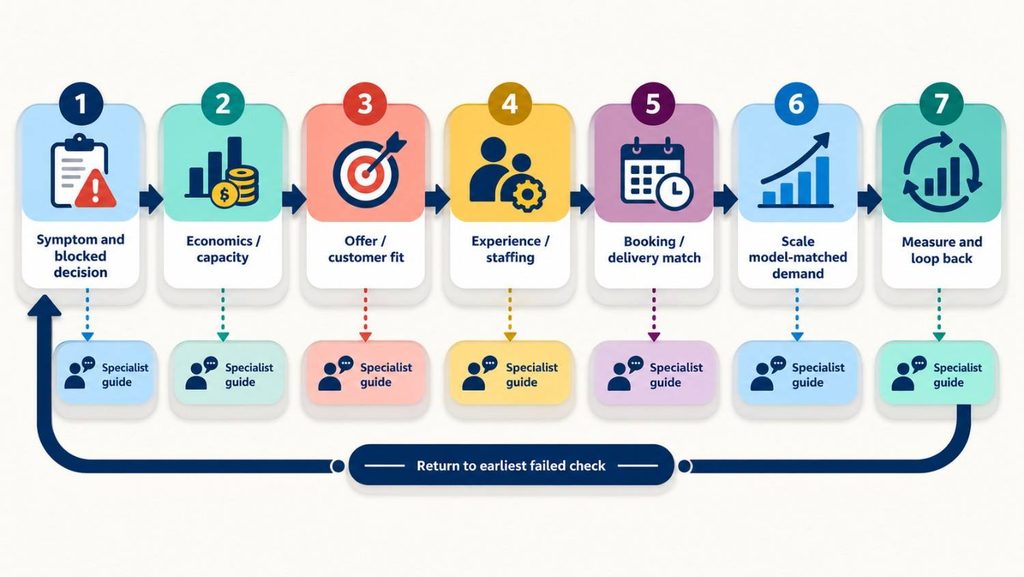
Diagnose from the earliest constraint forward; do not scale a downstream tactic into an unresolved upstream problem.
Apply this seven-step diagnostic:
- Name the symptom and the decision it is blocking. Replace a broad complaint such as “parties are not working” with an observable symptom: unclear contribution, booking abandonment, package confusion, host inconsistency, capacity strain, or weak follow-up. State the decision that cannot be made until the symptom is understood.
- Check economic health and real delivery capacity. Separate booked activity from delivered results. Review the venue’s defined economics, labor behavior, constrained resources, and remaining capacity. If those are unknown, the uncertainty is the first constraint.
- Check whether the offer fits the intended customer and occasion. Confirm the model, audience, age or occasion, group flow, package logic, and exclusions. Look for promises that attract a customer the venue is not designed to serve.
- Check experience design and staffing together. Map the child’s and parent’s journeys, then assign ownership for recognition, transitions, communication, logistics, and recovery. A staffing problem may actually be an overcomplicated product; an experience problem may actually be an unowned handoff.
- Check whether booking communications and internal handoffs match day-of delivery. Compare the public page, checkout, confirmation, internal record, schedules, check-in, attraction and food timing, final payment, and follow-up. Repair the first mismatch, not just the last complaint.
- Scale only the demand that matches the chosen model and credible capacity after the earlier gates are sound. Select channels and offers based on customer fit and operating readiness. Use controlled tests when uncertainty remains, and keep the feedback path short enough to correct the program.
- Measure the result, then return to the earliest domain that is still failing. Review economic, funnel, delivery, and customer signals together. Do not let a loud downstream symptom distract from an earlier unresolved constraint.
This sequence is deliberately circular. The operating system changes as staffing, capacity, customer mix, and venue conditions change. A fixed program can become a new constraint later. Diagnosis is a management habit, not a one-time launch exercise.
Choose the Next Guide for the Constraint You Found
Once you identify the constraint, use it to choose the next guide:
- Economics unclear: move to Stop Measuring Birthday Success by Party Count, then the pricing or premium-versus-volume guides as needed.
- Package or customer fit unclear: use the package-simplicity, age-segmentation, or real-customer guide.
- Child or parent value weak: use the birthday-child recognition or parent-relief guide.
- Host delivery inconsistent: use the dedicated-host role guide, then the host-training guide.
- Booking and delivery disagree: use the online-booking guide and the promise-to-delivery guide.
- Demand is wrong or premature: use the demand-design guide after the readiness gates are sound.
- Follow-up is fragmented: use the post-party CRM and follow-up guide.
- Measurement cannot identify the constraint: use the full birthday-party KPI dashboard guide.
Build the FEC Birthday Party Program You can Deliver
A durable FEC birthday party strategy comes from alignment. The economics support the model. The offer fits a real customer and occasion. The child and parent receive designed value. The dedicated party host and supporting team know who owns each handoff. Booking communicates the same promise the floor can deliver. Marketing brings demand the operation can absorb. Revenue, retention, and measurement close the loop.
The next action is not to adopt every tactic in this guide. Name one symptom that is blocking a decision. Work through the diagnostic until you find the earliest failing domain. Assign one owner, one evidence check, and one specialist guide to that constraint. Repair it, measure again, and only then decide whether the system is ready for more demand.
After you identify the constraint, Attractions Marketing Pros can help evaluate the marketing and booking side of the system. Book a free 30-minute Birthday Booking Audit; we will review your current calendar, offer, pricing, and booking flow and identify the gaps to address next.