A party host creates value through designed ownership, attention, continuity, and judgment – not merely by carrying food, cleaning a room, or wearing a name tag.
In a facilitated FEC birthday party, the host can be part of the product because the role changes how the same rooms, attractions, transitions, and service moments are experienced. But a job title or a friendly employee is not enough. The operating model must give the host something meaningful to own, enough attention and continuity to own it, and enough support to stay connected to the group.
FECs often define the host as labor attached to a package: set up the room, bring food, watch the clock, clean, and move on. Those tasks are essential, but they do not define an experience.
A Premium party makes a different promise. The host helps create the product as a character, animator, magician, or game leader; accompanies children to attractions; draws parents into playful moments; and keeps the birthday child at the center. The attractions still matter. The host turns them into one coherent occasion.
Direct answer. The FEC party host becomes part of the birthday-party product when the role owns the group’s experience rather than a list of isolated tasks. That requires defined responsibility, continuous attention during the moments that matter, permission to make bounded choices, and reliable handoffs when another employee must solve a logistical or operational problem.
The Labor-Only Definition Misses the Operator Decision
Most public party-host descriptions focus on duties: greet guests, prepare the room, serve food, enforce rules, guide activities, answer questions, and clean up. That is useful for staffing a shift. It does not answer the more important product question: What should this employee cause the customer to experience?
A room can be clean and the food can arrive on time while the party still feels generic. The birthday child may be treated like every other visitor. Parents may have to gather the group, ask when food is coming, find an employee, and reorganize the schedule after a delay. The basics were completed, but nobody owned the occasion.
The opposite problem also occurs. An energetic host can be warm, funny, and memorable while broken attractions, missing food, poor staffing, or an inflexible schedule destroy the package around that person. Personality cannot substitute for an operating system.
That leaves operators with three different questions:
- Which service tasks must be completed for the package to function?
- Which moments require human attention, judgment, and continuity for the promise to feel real?
- Which problems belong to the host, a runner, an attraction employee, a manager, or the system itself?
The host becomes part of the product in the second question. The first and third questions determine whether the host has a fair chance to deliver it.
When Does the Host Become Part of the Product?
I think of a Premium host as something closer to a stand-up performer or magician than a room attendant. A performer does not merely occupy the stage. The performer directs attention, reads the audience, changes pace, and selects moments when one person becomes part of the show.
At a Premium birthday party, the birthday child is that person. The host gives the child meaningful choices, invites the child into games or magic moments, and lets the rest of the group participate without losing sight of whose occasion it is. Attractions outside the room become tools in the performance. The host frames them, carries the energy between them, and turns several disconnected activities into one story the family can remember.
This is what it means for the host to become the party. It does not mean the host must talk constantly, force attention onto a shy child, or perform the same routine for every age group. It means the host is actively reading and shaping the social experience.
Birthday University uses the metaphor ‘party mechanic’ for this integrator: the person who makes the party’s components work together as one experience. The phrase is useful because the host connects attractions, transitions, parents, and support staff instead of merely completing isolated tasks.
Five operating conditions make that possible:
- Ownership. The host knows which parts of the experience belong to the role and which decisions belong elsewhere.
- Continuity. The host remains present across the moments where a handoff would break context, trust, or energy.
- Attention. The host is not so overloaded with food, supplies, cleanup, and simultaneous parties that guest contact disappears.
- Judgment. The host can choose an age-appropriate game, redirect a disengaged group, dial the energy up or down, and respond within approved boundaries.
- Support. Runners, attraction staff, kitchen employees, managers, and systems handle the work that the host cannot credibly absorb without leaving the party.
Remove any one of these conditions and the role becomes harder to sell as part of a Premium product. A continuously assigned host without judgment is a chaperone. A charismatic host without support becomes a runner. A trained host without working attractions becomes the visible face of someone else’s failure.
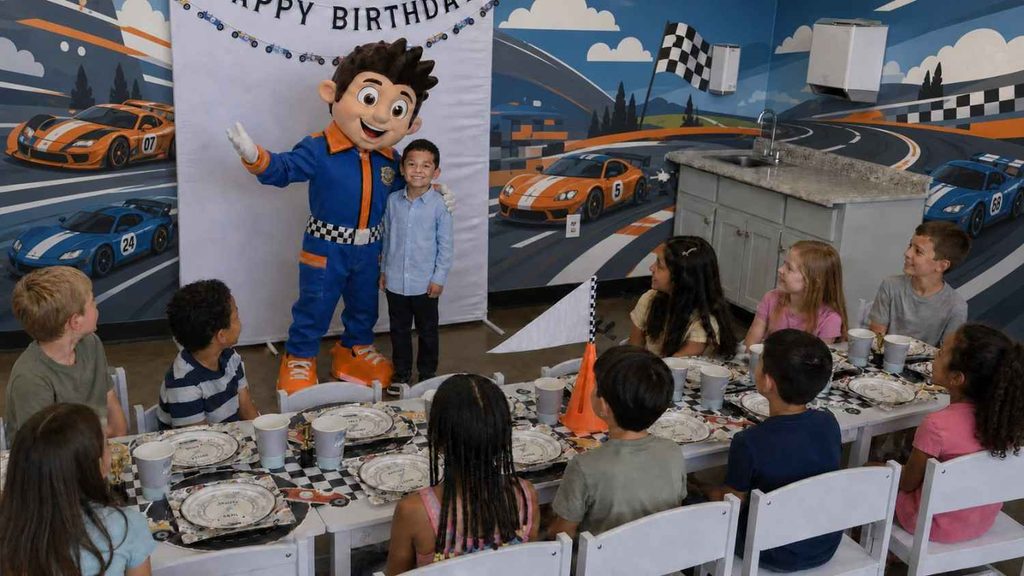
Premium birthday-party experience with a dedicated character host posing beside the birthday boy as guests sit at a fully themed room
What Should the Host Own Across the Party?
The exact allocation depends on the venue, package, age group, and operating model. Still, a facilitated party usually contains several moments where visible ownership matters.
Arrival and Role Framing
The host should know the party plan before the family arrives, greet the parent and birthday child, confirm the important details, and explain what will happen next. The goal is not a long speech. It is to establish one clear point of contact and reduce the feeling that the parent must discover the process while the clock is already running.
Birthday-Child Recognition and Group Energy
The host should learn how the birthday child wants to participate. Some children want to answer every question and lead every game. Others prefer one or two moments of recognition. The host can offer bounded choices – which game to play, which attraction to visit first, who will help with a magic trick – while keeping the rest of the children engaged.
A strong host makes the child the center without making the group feel like an audience that does not matter. The host notices who is disengaged, invites participation, involves parents when that will delight the children, and changes the energy before a lull becomes disorder.
Attractions and Transitions
Moving from a party room to an attraction is not empty time. It is where groups scatter, parents become uncertain, and the experience can lose momentum. A Premium host stays connected, frames the next activity, supports approved rules, and keeps the group moving without making the event feel rushed.
In a lighter model, attraction staff or standardized instructions may own this moment. That can work. The important point is that somebody owns the transition and the customer promise accurately describes the level of support.
Parent Communication and Recovery
Parents should not have to repeatedly ask what is happening, search for the host, or coordinate multiple departments. A host can reduce that burden by giving short updates, explaining changes, and keeping the parent informed when the schedule moves. The host also needs a clear recovery boundary. The role may choose another game when the age mix changes, redirect a crying child, adjust the order of attractions, or offer an approved alternative when a minor issue appears. Inventory shortages, refunds, safety decisions, major downtime, and package changes may require a runner or manager. The host should preserve the relationship and the context while the correct person solves the problem.
The Premium Host Needs Support, Not Extra Errands
In a Premium model, food, drinks, supplies, room resets, missing items, and similar logistics should be designed around the host’s primary job: entertainment and experience ownership. That does not make runner or service work less important. It makes the division of attention explicit.
Think again about the performer on a stage. Guests would not order food from the comedian during the show. Another employee protects the performance by handling the transaction. The same logic can apply to a birthday host. If the host repeatedly leaves the group to locate plates, refill drinks, check a kitchen ticket, or clean another room, the venue has sold continuity and staffed interruption. The allocation can change in Hybrid or Volume models. One employee may reasonably combine hosting and service work when the promised experience is lighter, the group is more independent, or the operation is intentionally standardized. The mistake is not combining tasks. The mistake is making a Premium promise while scheduling the role like a runner.
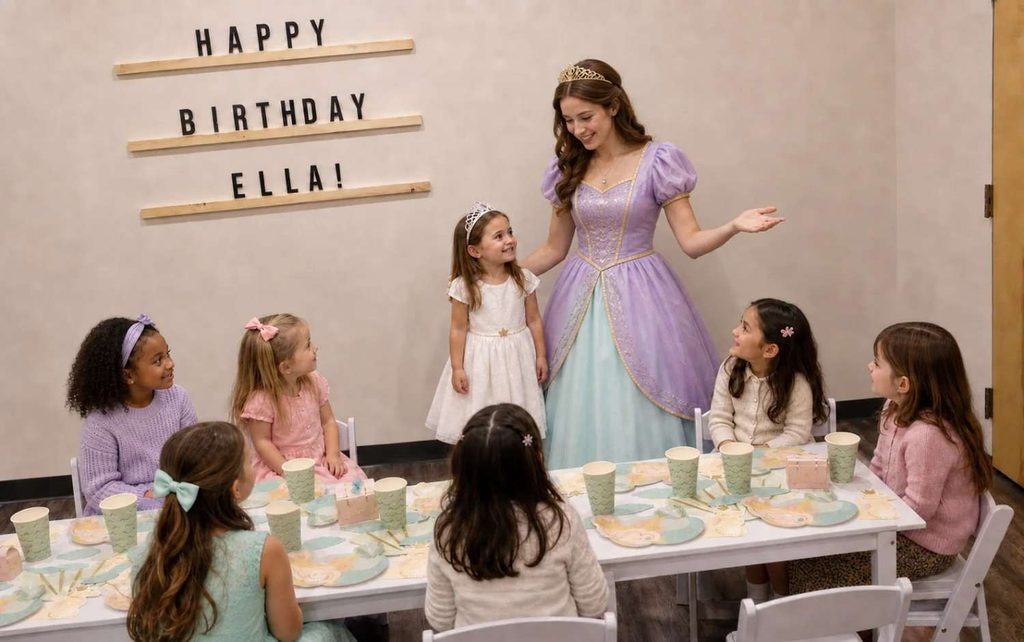
Hybrid birthday-party experience combining themed décor and a princess host with a structured table celebration for a young birthday girl.
Dedicated, Shared, or Light-Touch is a Product Choice
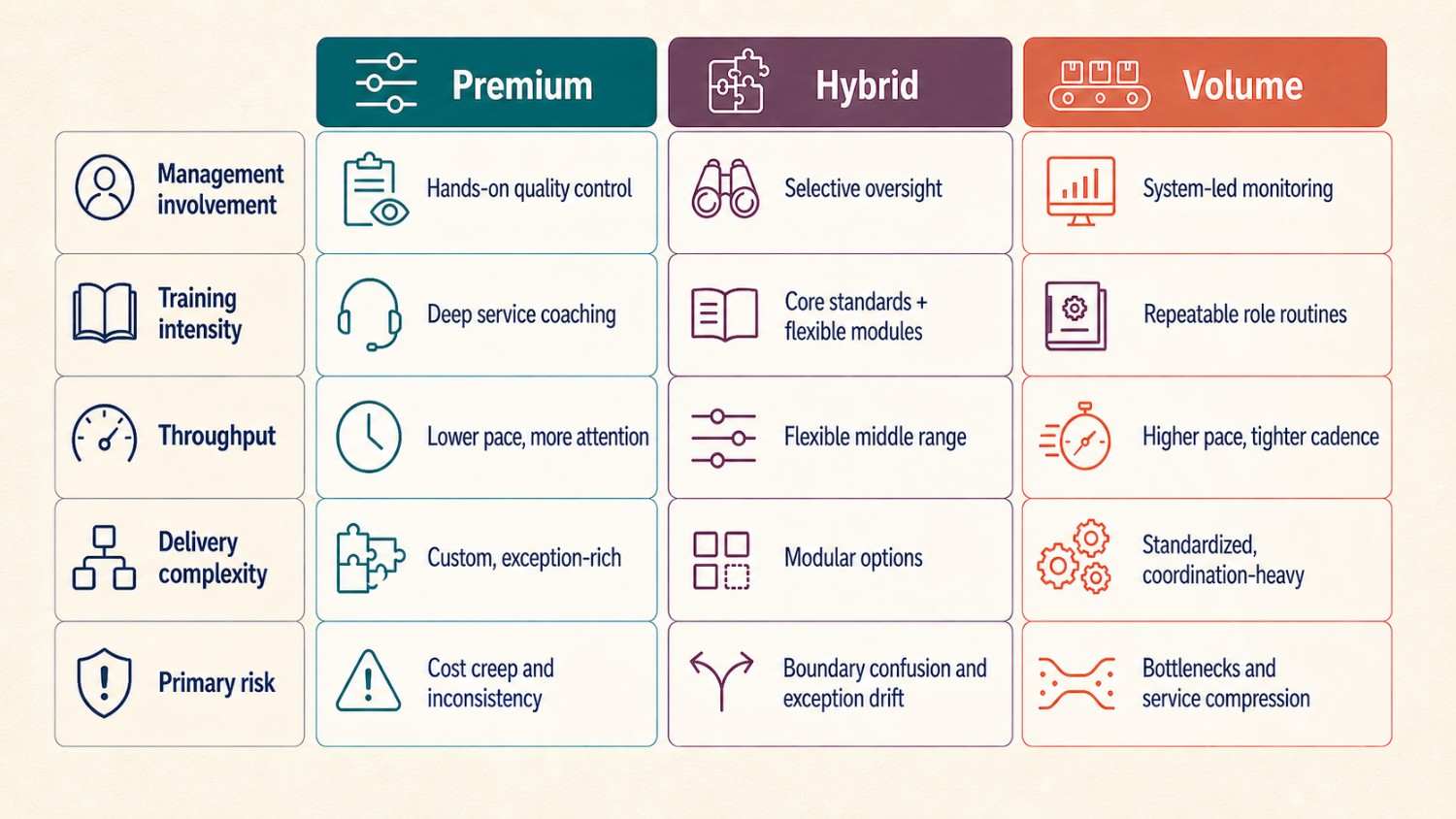
Premium, Hybrid, and Volume are not a quality ladder. They are different operating choices. A coherent model aligns the promise, host role, staffing, handoffs, and parent expectations.
| Model | Continuity | Host role | Operating implication |
| Premium | Dedicated through the experience | Character, animator, facilitator, and experience owner; participates beyond the party room | Requires exceptional people, deeper training, runner support, and clear recovery paths |
| Hybrid | Dedicated at selected moments; shared elsewhere | Light performance or character work, room facilitation, birthday recognition, and planned handoffs | The operator must identify exactly which moments receive Premium attention |
| Volume | Standardized or shared coverage | Facilitator or runner focused on fulfillment, throughput, check-ins, and escalation | Works when the promise is clear, basics are reliable, and parents or attraction teams own more of the flow |
Editorial model note: These labels describe operating choices used in this article. They are not audited classifications of individual companies and should not be used to rank venues. Premium depends most heavily on an A-player host who enjoys children, reads people well, and can turn performance talent into repeatable behavior. Hybrid narrows that performance to selected moments. Volume depends less on one continuous performer and more on reliability, clarity, speed, and escalation.
What the Review Patterns Reveal
How the review scan was built. We reviewed the newest Google reviews from fifty Premium venues, one hundred Hybrid venue, and one hundred Volume venues. We coded recurring positive and critical themes, and a review could receive more than one theme.
The strongest signal was human on both sides of the rating scale. Positive reviews repeatedly praised staff or service, often naming a specific employee. Reviewers also described child and family enjoyment and positive birthday experiences through observable staff actions.
Critical reviews showed the reverse pattern. Staff or service failures were the dominant complaint theme, often appearing alongside attraction unavailability, missing floor coverage, weak communication or recovery, food problems, cleanliness concerns, and safety or supervision issues.
Birthday-specific comments made the mechanism easier to see. Positive comments emphasized attentiveness, coordination, preparation, check-ins, and making the child feel special. Critical birthday comments more often described failures of staffing, coverage, ownership, or recovery.
The model comparison produced a more surprising result: staff praise appeared at almost the same rate in the Premium, Hybrid, and pooled Volume slices.
The useful conclusion is not that one model receives praise while another does not. Customers notice people in every model. What changes is what those people are expected to make coherent – and where the surrounding operating system can overwhelm them.
In the Premium comparison, the host was part of the core attraction. Reviewers described immersion, humor, pacing, and emotional energy. In the Hybrid comparison, the clearest host value was reducing parent workload through preparation, attentiveness, party-room support, and cleanup. In the Volume comparisons, reviews depended more heavily on floor coverage, attraction uptime, food readiness, and recovery authority.
The Premium slice was overwhelmingly positive and contained no low-star reviews in the selected window. That is an observed sample limitation, not proof that Premium models are inherently better or that the venue receives no complaints.
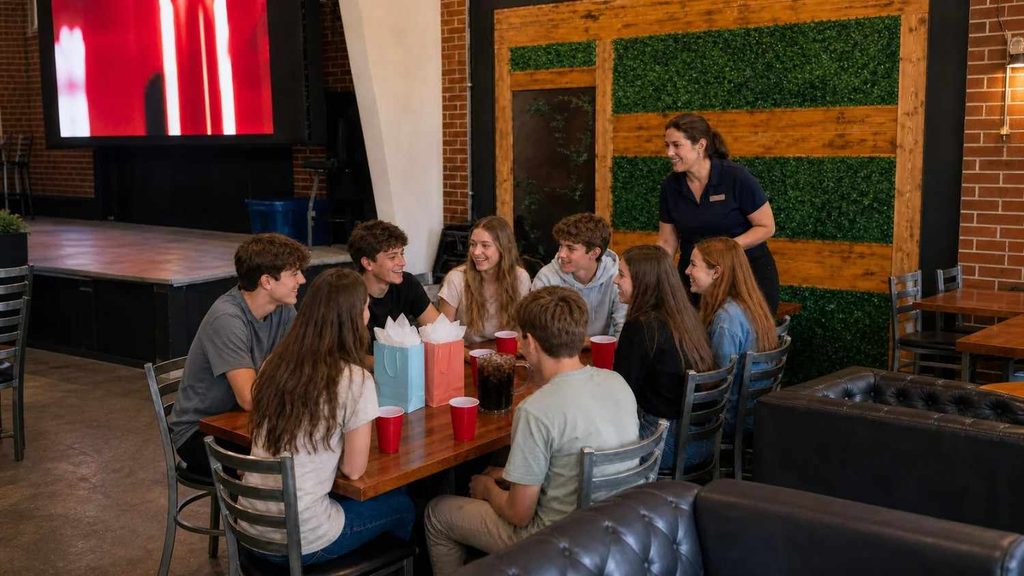
Volume birthday-party model with teenagers sharing a simple group table while a venue host assists.
The Host is Part of the Product, But Not the Whole Product
The most useful critical reviews combined human and system failure. Families sometimes praised friendly employees but rejected an experience because attractions were unavailable, food was late, or venue-caused delays consumed the package clock. The host alone cannot determine the result: no employee can manufacture uptime, serve unprepared food, cover unstaffed zones, or authorize a recovery the business has not approved.
The role can still matter in those moments. A good host notices the problem early, preserves the group’s context, explains what is changing, uses approved alternatives, and closes the loop with the parent. But the business must give the employee a functioning product and a credible escalation path.
That is the boundary operators should remember: the host can coordinate the experience; the host cannot replace the experience.
Protect the Host’s Attention with Handoffs and Decision Rights
A handoff is not merely telling another employee that something is needed. A useful handoff carries the party’s context: who the customer is, what was promised, what changed, what has already been tried, and who will confirm completion.
In Premium delivery, the host should remain the relationship owner while a runner, kitchen employee, attraction attendant, or manager completes the specialized task. The host may change the order of games, select a more appropriate activity, lower the energy for an overwhelmed group, or redirect a child who is upset. A manager may need to approve price change, solve a double booking, address major downtime, or change a package.
Hybrid and Volume models can distribute those responsibilities differently. What cannot be distributed is accountability. If every department assumes somebody else updated the parent, the family experiences silence. If everybody is watching the party, nobody may notice that the experience is drifting.
Decision rights should therefore answer three simple questions before the shift begins:
- What may the host change immediately without asking?
- What approved options may the host offer when a common problem occurs?
- Which issues require immediate escalation, and who is expected to respond?
Measure What the Host Actually Influences
Reviews can reveal what customers notice. They cannot, by themselves, prove that a dedicated host caused a higher rating, a repeat booking, a referral, or additional profit. Venues differ in attractions, age mix, pricing, food service, capacity, review solicitation, management, and customer expectations.
Start closer to the work. Observe whether the host framed the role, recognized the birthday child, included the group, communicated with the parent, protected transitions, completed handoffs, and closed problems. Compare those observations with review themes, complaints, and repeat behavior over time.
Financial conclusions require another layer: clear definitions, a baseline, a change date, a comparison, and attention to competing explanations. The practical discipline is simple. Measure each link in the chain instead of jumping from a charismatic employee to a revenue claim.
Choose the Promise Before You Hire the Person
Before rewriting the party-host job description, decide what product the role is supposed to deliver. Use five questions:
- What does the family believe it purchased: a room and inclusions, selected hosted moments, or a continuously facilitated experience?
- At which moments would the experience lose value if the host disappeared or changed?
- Which food, supply, cleanup, and service tasks will interrupt guest contact, and who should own them?
- What choices may the host make, what options may the host offer, and when must a manager step in?
- Which failures come from the host, and which come from booking design, staffing, kitchen flow, attraction readiness, or policy?
A Premium venue should be honest about the cost and complexity of the answer. The host is a central performer, not an easily interchangeable runner. The operation needs stronger selection, training, coaching, support, and continuity.
A Hybrid or Volume venue should be equally honest. A lighter host model can be coherent and valuable when the promise is clear and the basics work. It becomes a problem only when marketing sells a deeply facilitated party and operations delivers occasional check-ins.
The title does not make the host part of the product. The design does.
The Party Host is Where the Promise Becomes Human
FEC owners invest in rooms, attractions, food, systems, decorations, and technology. Customers experience those investments through moments: someone greets them, notices the birthday child, protects a transition, explains a delay, and determines whether the group feels like a party or a collection of purchases.
In a Premium model, that someone is the continuously assigned party host. In Hybrid and Volume models, the work may be shared or standardized. Every model can be legitimate. What matters is that the promise, staffing, handoffs, and authority agree.
Related reading: The Broken Windows of Your FEC: How Small Details Quietly Destroy Customer Trust explains why marketing and operations are two parts of the same promise.
Want to diagnose whether your birthday marketing promise matches the experience your team can deliver? Start with the Attractions Marketing Pros birthday growth review.
Frequently Asked Questions
What is an FEC party host?
An FEC party host is an employee who may combine package-fulfillment tasks with experience ownership. Depending on the venue’s model, the role can include welcoming the group, recognizing the birthday child, leading games, facilitating attractions, communicating with parents, managing transitions, coordinating handoffs, and escalating problems.
Does every FEC birthday party need a dedicated host?
No. A dedicated host is central to the Premium model described here, but Hybrid and Volume formats can use shared, standardized, or light-touch hosting. The staffing design should match the experience promised to the customer.
What is the difference between a party host and a party runner?
The host may own guest continuity, energy, communication, and personalization. A runner may protect that attention by handling food, drinks, supplies, setup, cleanup, and other logistics. Some venues combine the roles; others separate them.
How does a party host make the birthday child feel special?
The host can use the child’s preferred name, offer bounded choices, invite the child into games or performance moments, and recognize the occasion without forcing unwanted attention. The group should remain included.
Can a party host reduce the parent’s workload?
Yes. A well-designed role can reduce repeated questions, coordination between departments, timeline management, and uncertainty. The amount of relief depends on the model and the responsibilities the venue has actually staffed the host to own.
What does ‘party mechanic’ mean?
Birthday University uses ‘party mechanic’ as a teaching metaphor for the person who makes the party components work together as an experience. It is useful industry language, but ‘FEC party host’ remains the clearer public and search term.